Transparent information pursuant to the EU Disclosure Regulation (Sustainable Finance Disclosure Regulation – TVO) on how sustainability risks (ESG) are taken into account in our advice.
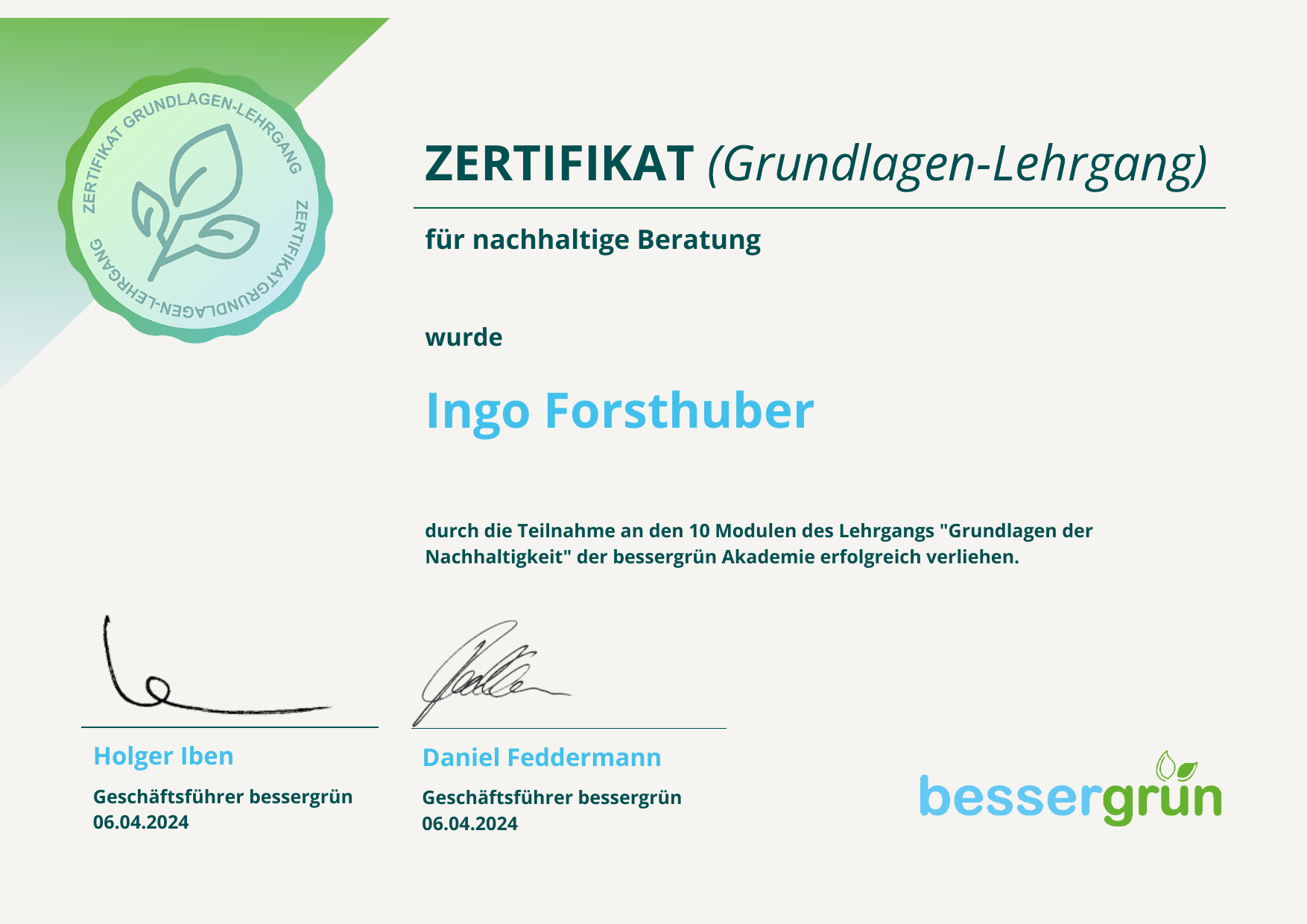
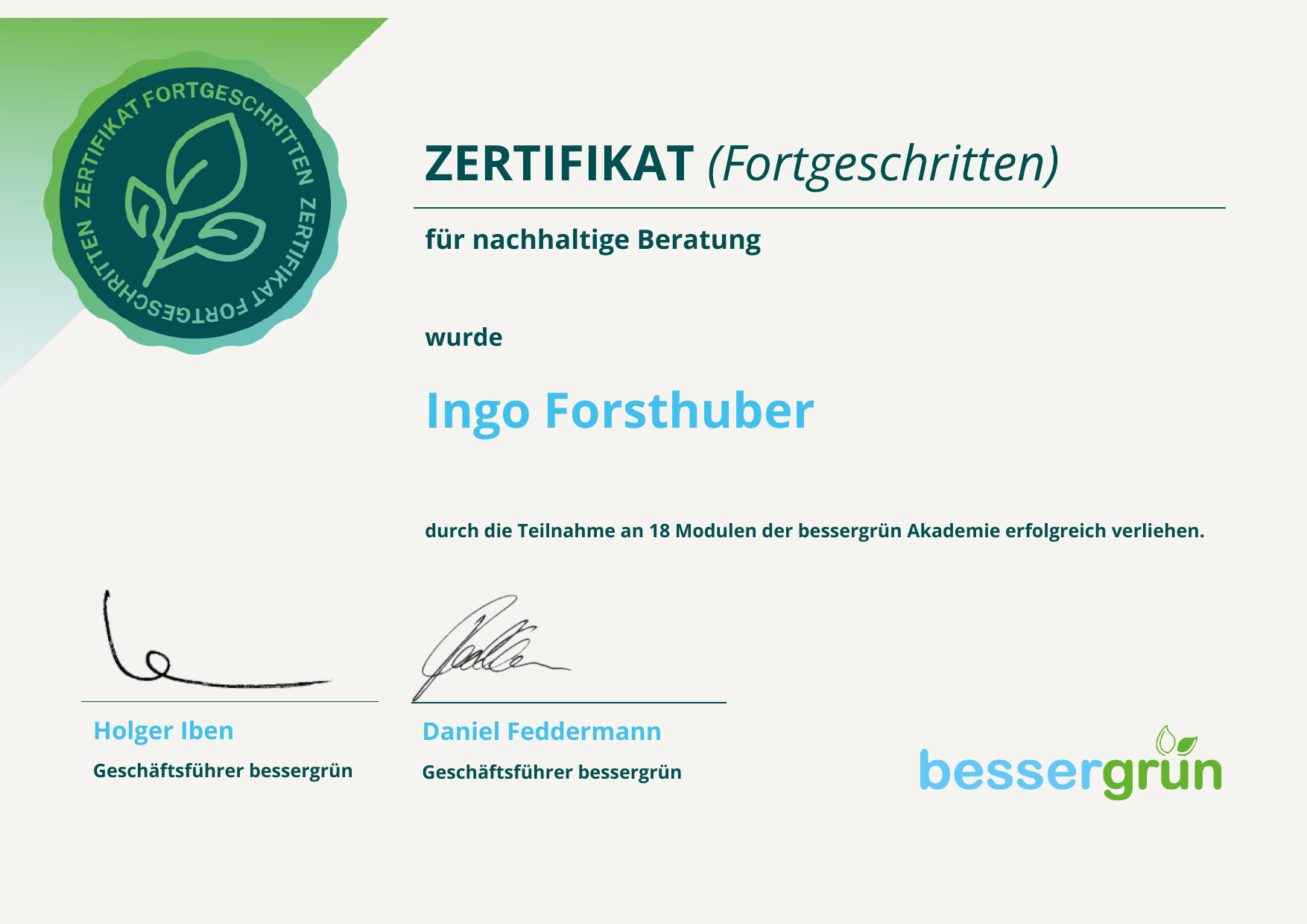
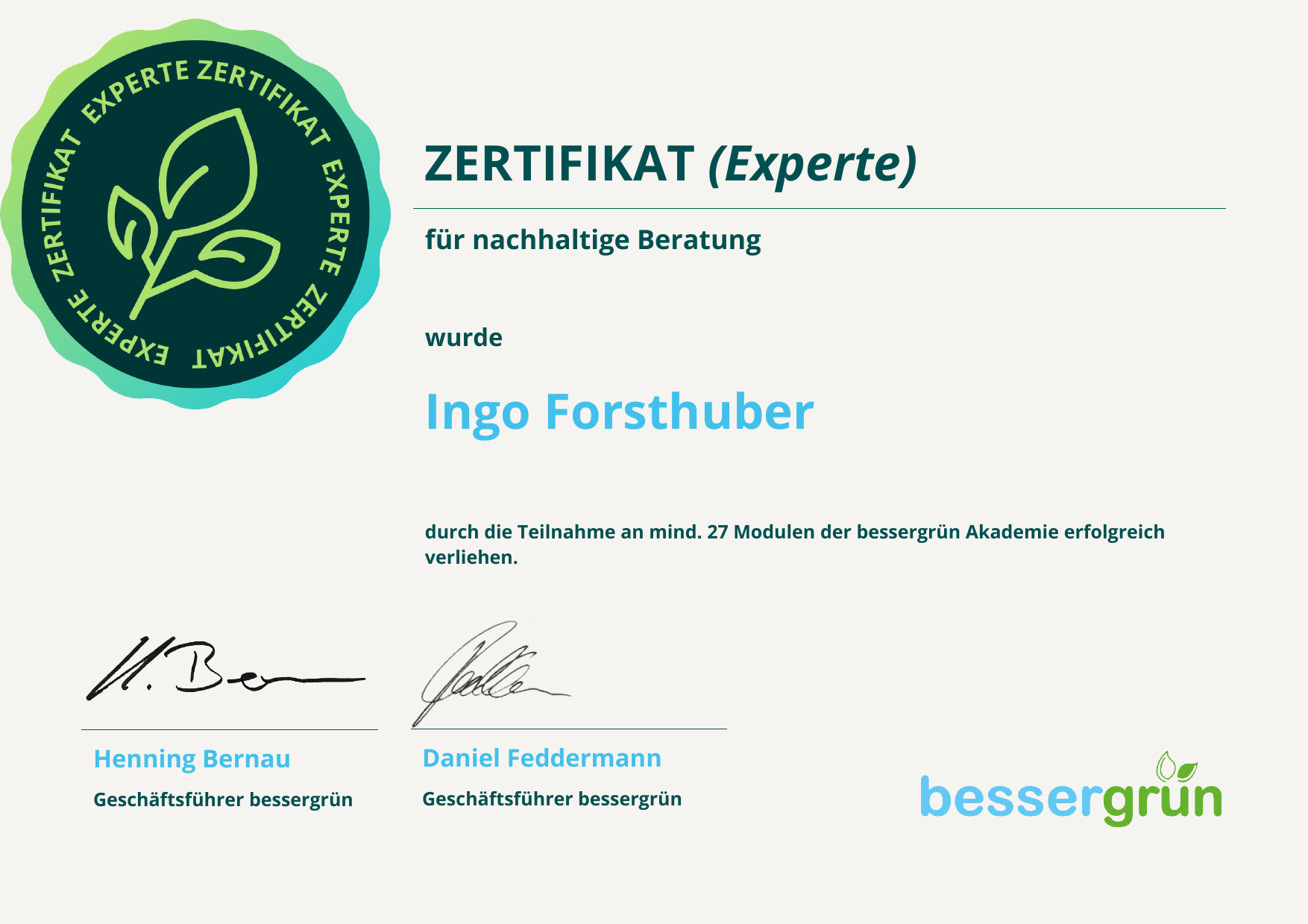
Our founder Ingo Forsthuber has completed the courses of the bessergrün Akademie. Click on a certificate to view it enlarged.
Sustainability risks (ESG risks) are events or conditions in the three areas of environment, social and governance which, if they occur, could have a negative impact on the value of the investment. These risks can affect individual companies as well as entire industries or regions.
Environment: As a result of climate change, increasingly frequent extreme weather events could pose a risk. This risk is also called physical risk. One example would be an extreme dry period in a particular region. As a result, water levels of transport routes such as rivers could fall so far that the transport of goods could be impaired.
Social: In the social area, risks could arise, for example, from non-compliance with labour law standards or health protection.
Governance: Examples of risks in the area of corporate governance include tax non-compliance or corruption in companies.
In order to take sustainability risks into account in advice, the information made available by providers (financial market participants) about themselves and their financial products is considered when selecting them. Providers that recognisably have no strategy for integrating sustainability risks into their investment decisions may not be offered. Where taking sustainability risks into account in the investment decision entails recognisable advantages or disadvantages for the customer, this may be presented separately during the advice. Each provider informs about how it takes sustainability risks into account in its investment decisions in its pre-contractual information. The customer can raise questions about this before a possible conclusion of a contract.
Statement on the consideration of the principal adverse impacts on sustainability factors in investment and insurance advice:
In our advice, our aim is to be able to recommend a suitable investment/insurance-based investment product to you. In doing so, we also take your sustainability preferences into account if you so wish. You can specify whether environmental and/or social values as well as principles of good corporate governance and/or the principal adverse impacts of investment decisions on sustainability factors should be taken into account in your investment. Depending on the type of investment objective (investment in companies, states, real estate, etc.), the legislator has defined "indicators" for the principal adverse impacts of investment decisions on sustainability factors in the following areas:
Product providers are legally obliged to publish a statement on the strategy they pursue with regard to considering and dealing with the principal adverse impacts. This relates in particular to greenhouse gas emissions, water consumption, biodiversity, waste, social and employee matters (including human rights and corruption). If you decide that the principal adverse impacts of your investment decisions on sustainability factors should be taken into account in the product selection, we take into account the information provided by the product providers and the strategies they have set out as part of the selection process. We do not apply our own classification and selection methods to the product providers' information. The product providers' information is not separately checked for plausibility.
The remuneration for the intermediation of financial products is generally not influenced by sustainability risks. Providers may pay higher remuneration for taking sustainability risks into account in investments. If this does not conflict with the customer's interests, the higher remuneration is accepted.
Would you like advice? Feel free to talk to us about your individual sustainability preferences – get in touch now.
This page is a translation of our German website. The German version is authoritative: in the event of any discrepancies or ambiguities, only the German version is legally binding, not the translation. We offer advice in German or English. You will receive contracts, insurance terms and documents in German.