Occupational Disability Insurance Compared: Why Policy Terms Matter More Than Ratios
Stars, percentages and rankings look good – but in the end, what counts is your contract. We analysed three strong tariff lines and the 2026 occupational disability (BU) market, and explain here in plain language what really matters.
Key points at a glance
- A claims acceptance ratio or a litigation ratio gives you orientation, but it does not decide your entitlement.
- What counts is always the specific tariff with its version of the policy terms – not the name of the company.
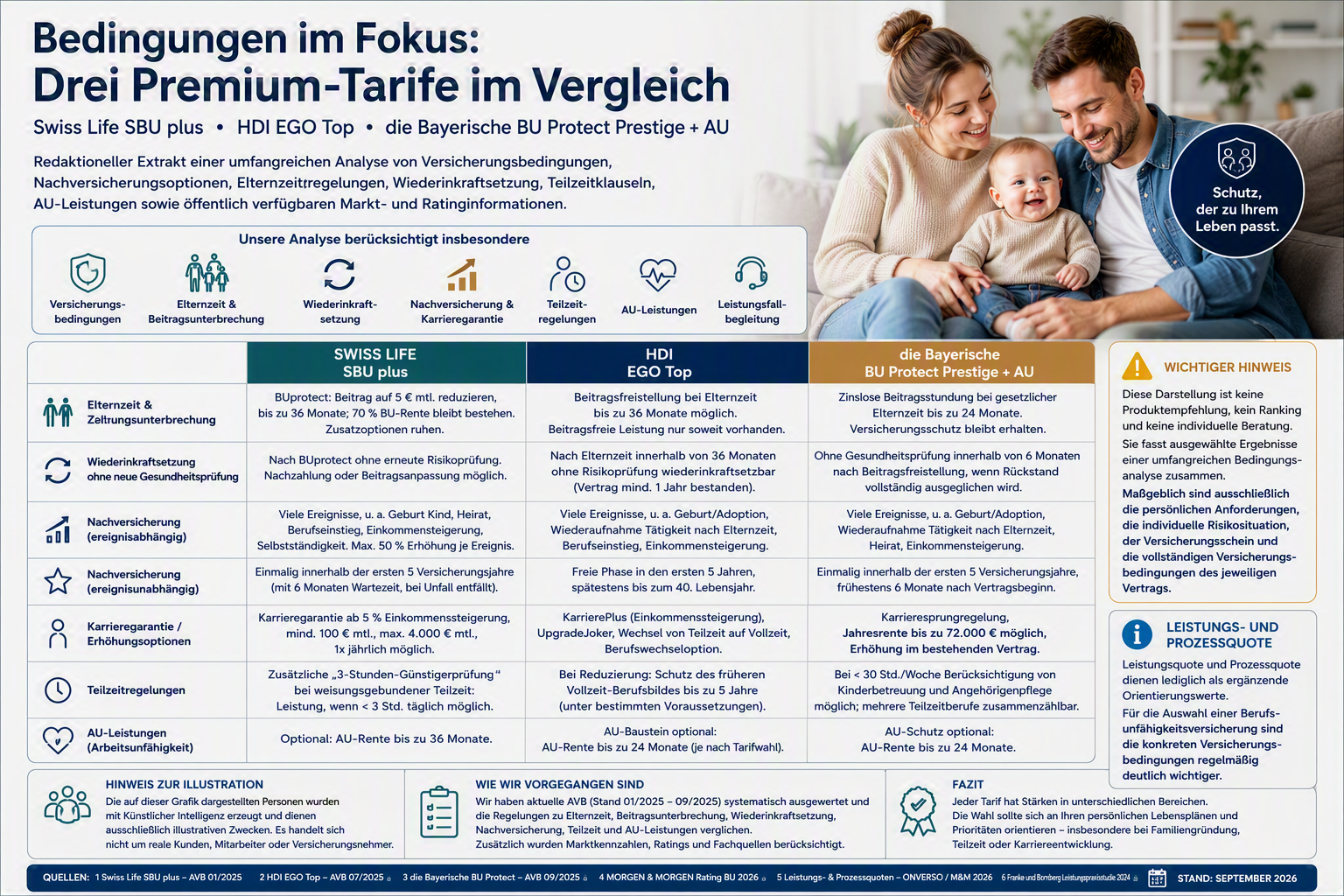
- In the premium segment, Swiss Life SBU plus, HDI EGO Top and die Bayerische BU Protect Prestige + AU show different strengths in parental leave, reinstatement, top-up options, part-time work and inability to work.
- There is no overall winner across the board. There is only the tariff that fits your life.
Four terms you should know
- Claims acceptance ratio: the share of BU benefit claims accepted in an analysis. It looks backwards and depends on the portfolio and the structure of the cases.
- Litigation ratio: the share of disputes that end up in court. Depending on the calculation method, the reference base and how settlements are counted, different values result.
- Claims support: professional support when it matters – job description, medical evidence, deadlines, communication.
- Policy terms: the contractual basis of your entitlement. This is where you find the BU definition, referral to other occupations, forecast period, follow-up review, duty to cooperate, part-time work and top-up options.
Why the policy terms matter so much
The policy terms determine when occupational disability exists at all within the meaning of your contract, and which rights and obligations apply. A good ratio at company level cannot make up for a weak clause or one that does not suit you. Conversely, a conspicuous ratio does not automatically mean that a particular premium tariff is unsuitable for you.
It is also important to note that an insurer often offers several tariffs and generations of policy terms at the same time. Claims and litigation ratios are company figures and do not apply to an individual tariff. That is why we strictly separated the company level from the tariff level and documented the tariff name, tariff variant and version of the policy terms.
So the key question is not: Which insurer has the nicest ratio? But rather: Which specific tariff, with its documented policy terms, fits your career and family plans?
How we went about it
- We classified the claims acceptance ratio and the litigation ratio as backward-looking company figures.
- We then identified the current versions of the policy terms for the selected tariffs.
- Above all, we compared topics relevant to family and career: parental leave, premium relief, reinstatement, top-up options, part-time work and benefits for inability to work (AU).
- We used product information only as a supplement. What counts remains the complete set of policy terms as well as the application, the policy document and individual clauses.
- Where a provision could not be clearly established from the publicly accessible passages, we did not assume any benefit.
Our weighting
For a comparison focusing on family planning, part-time work and career, we weighted tariff-specific provisions much more heavily than historical company figures. This weighting is our editorial method and not part of the insurance contracts.
| Criterion | Weight |
|---|---|
| Basic definition, referral to other occupations and follow-up review | 20 % |
| Parental leave, payment break and reinstatement | 20 % |
| Top-up options and career options | 20 % |
| Part-time work and relevant occupational profile | 15 % |
| AU benefit and immediate assistance | 10 % |
| Claims process and expertise | 8 % |
| Premium stability | 4 % |
| Claims acceptance ratio | 2 % |
| Litigation ratio | 1 % |
The three tariff lines examined in detail
Here, we refer to three high-performing tariff lines as top products; we examined them in depth because of their documented product features and their relevance to family and career questions. This does not mean they are overall test winners.
1. Swiss Life SBU plus
Policy terms version 01/2025 (AVB_EV_SBU_2025_01). Supplementary product information describes BUprotect as a payment bridge for certain financial bottlenecks – according to the product information, for up to 36 months with a premium of 5 euros and 70 % of the BU pension as residual cover. The offer and the contract are decisive for the specific use and duration.
- Focus: premium relief with defined residual cover via BUprotect.
- Top-up options and career options are key areas to check; according to the product information, the career guarantee is limited to 20 % for the self-employed, and the overall cap is a BU pension of 4.000 euros.
- For part-time work, the documented three-hour more-favourable test is particularly relevant: if the BU degree of 50 % is not reached, an additional check is made as to whether the part-time activity would still be possible for three hours a day.
- Optional AU cover is provided for in the policy terms (according to the analysis of the general terms, for up to 36 months).
2. HDI EGO Top
Policy terms version 07/2025 (AVB_HBV26_250701).
- Focus: explicitly structured provisions on premium exemption and reinstatement – parental leave is addressed in a separate section (§ 25), general reinstatement in § 24.
- HDI lists NVG Top, KarrierePlus, UpgradeJoker and an occupation change option as product features.
- The level of cover during a premium exemption depends on the premium-free benefit stated in the contract.
- EGO Top is available with benefits for sick leave or inability to work; a full waiver of referral to other occupations and a first-aid benefit for cancer are also mentioned.
3. die Bayerische BU Protect Prestige + AU
Policy terms 26L07, version 09/2025. They separate basic benefits from optional additional benefits; AU cover and Prestige cover are governed in separate sections. This can only be assessed if both options are actually included in your policy document.
- Focus: modular combination of BU Protect, optional Prestige cover and optional AU cover (§§ 6 to 8).
- Event-related and event-independent top-up options without new health questions are important parts of the review; what is checked is financial appropriateness.
- For parental leave, deferral, reinstatement and part-time work, the exact wording of the complete set of contract terms must be consulted.
The focus areas at a glance
| Area checked | Swiss Life SBU plus | HDI EGO Top | die Bayerische BU Protect Prestige + AU |
|---|---|---|---|
| Parental leave / payment break | BUprotect according to product information; note the terms of the individual contract | Parental leave explicitly addressed in a separate section of the general terms | Check the specific deferral or premium exemption rule in the contract terms |
| Reinstatement | Check provisions on payment difficulties and contract changes | Separate § 24 and special provision in § 25 | Check the deadline, back payment and risk assessment in detail |
| Top-up options | Event and career options | NVG Top and KarrierePlus | Event-related and event-independent options |
| Part-time work | Three-hour more-favourable test documented | Check the relevant occupational profile when hours are reduced | Check part-time work and childcare situation in detail |
| AU benefit | Provided as an option | AU variant available | Optional AU cover in §§ 6 to 8 |
| Particular strength | Payment bridge and part-time test | Contractual structure for interruption and reactivation | Modular additional benefits |
What does a look at the overall market show?
Beyond the three tariff lines, we analysed the market. The MORGEN & MORGEN 2026 rating assesses 636 tariffs and tariff combinations from 59 companies and lists the tariff variant separately. That is exactly why we separate the company ranking from the tariff rating:
- Claims and litigation ratios refer to an insurer's portfolio and can include several tariff generations as well as SBU and BUZ contracts.
- Policy terms, by contrast, are assessed at tariff level – which requires the tariff name, tariff variant and version of the terms.
- A good company ranking does not mean that every tariff of that insurer is of the same quality.
The group with the least conspicuous figures includes, for example, HDI (EGO Top), DBV, Gothaer (SBU Premium), R+V (classic variant), the Deutsche Ärzteversicherung, Alte Leipziger (BV10), Nürnberger and Swiss Life (BU Flex 4U plus). Other companies with generally inconspicuous figures include Allianz, Debeka, ERGO, Stuttgarter, Dialog, LV 1871 (Golden BU) and Zurich. Where a current tariff variant could not be clearly verified from publicly accessible sources, we deliberately did not estimate it but marked it as "still to be verified".
Your checklist before deciding
- Record the exact tariff name, included options and version of the policy terms in the offer.
- Parental leave: document the start, maximum and minimum duration and the required evidence.
- Distinguish the type of relief: premium reduction, deferral or premium exemption.
- Have the level of BU cover during the relief phase confirmed in writing.
- Reinstatement: check the deadline, risk assessment, back payment of premiums and benefit level.
- Top-up options: check the events, age limits, deadlines, minimum and maximum increases.
- Career guarantee: check the income threshold, frequency, overall cap and the rule for the self-employed.
- Part-time work: check weekly hours, daily capacity to work and the relevant occupational profile.
- AU module: check the evidence, minimum duration, start of benefits, maximum duration and relationship to the BU claim.
- Take into account exclusions, surcharges and individual clauses in the policy document.
Our perspective as an insurance broker
We don't think much of rankings that boil everything down to a single number. What matters to us is whether your contract holds up when your life changes: a child, part-time work, a job change, a jump in salary or a financial dry spell. That is exactly where clauses on parental leave, reinstatement, top-up options and part-time work make the difference – not a ratio from the past.
That is why, in our view:
- If you want parental leave and reinstatement provisions that are clearly structured in the policy terms, HDI EGO Top is particularly relevant.
- If you want a documented payment bridge with a reduced premium and a special part-time test, Swiss Life SBU plus is particularly interesting.
- If you want to combine modules – BU, Prestige and AU – die Bayerische BU Protect Prestige + AU is particularly worth checking.
All three belong on the shortlist, but for different reasons. The final decision depends on your occupation, your income, the desired pension amount, your state of health, your family planning and the individual set of contract terms. And if things ever get serious, we support you with your claim – from the job description to communication with the insurer.
Frequently asked questions about occupational disability insurance
When is a good time to take out occupational disability insurance?
Taking it out early can be an advantage, because age, occupation and state of health influence acceptance and the premium. However, whether cover makes sense and which cover depends on your personal situation, your needs and the terms of the specific tariff.
How high should my BU pension be?
The right amount cannot be set across the board. The starting point is your disposable income, your ongoing expenses, existing entitlements and a reasonable margin for retirement provision and price increases. In addition, insurers apply individual acceptance limits and maximum limits.
Can I get occupational disability insurance despite pre-existing conditions?
Pre-existing conditions do not automatically lead to rejection. However, insurers may assess them differently and accept an application on standard terms, offer it with a surcharge or exclusion, defer it or reject it. A carefully prepared anonymous risk pre-assessment can help clarify possible conditions before a binding application. It cannot guarantee a particular acceptance.
What is the difference between occupational disability and reduced earning capacity?
Private occupational disability insurance is generally based on the most recent occupational activity and the agreed contract terms. The statutory reduced earning capacity pension, on the other hand, depends mainly on how many hours you can still work on the general labour market under the statutory conditions. Whether an entitlement exists, and in what amount, is assessed separately in each case.
Can I increase or adjust my BU cover later?
Many tariffs provide top-up or career options, for example in the event of a salary increase, marriage, the birth of a child or the purchase of a property. Events, deadlines, age limits, maximum amounts and a possible new risk assessment differ from contract to contract. That is why the terms of your specific tariff are decisive.
Sources
- Swiss Life: General terms SBU / SBU plus, version 01/2025 (AVB_EV_SBU_2025_01); product highlights and product information BUprotect.
- HDI: EGO Top policy terms, version 07/2025 (AVB_HBV26_250701); HDI product overview EGO Top.
- die Bayerische: BU Protect policy terms, version 09/2025 (policy terms 26L07); provider information on top-up options.
- MORGEN & MORGEN: Rating and market overview occupational disability 2026.
- Explanations of the calculation and limits of claims and litigation ratios; supplementary secondary sources for classifying individual provisions of the general terms.
Legal and editorial notice: This article is for general information purposes only and does not replace individual insurance or legal advice. Only the application, the policy document, individual clauses and the complete terms of the specific contract are decisive. Product information cannot replace the policy terms. The weighting presented is an editorial assessment method and not part of the insurance contracts.
👉 Want to know which BU tariff suits you? Simply get in touch with us – click on Request advice