
Switching health insurers in 2027: additional contribution, deadlines and family insurance
Every autumn, many statutory health insurers send out their contribution information for the new year. If you are asked to pay a higher additional contribution, you can switch. Here you will learn how switching works, which deadlines apply and which figures in statutory health insurance (GKV) are set to change in 2027.
Key points at a glance
- Contribution: 14.6 % general contribution rate plus an additional contribution set by each insurer. Employees and employers each pay half of the total contribution.
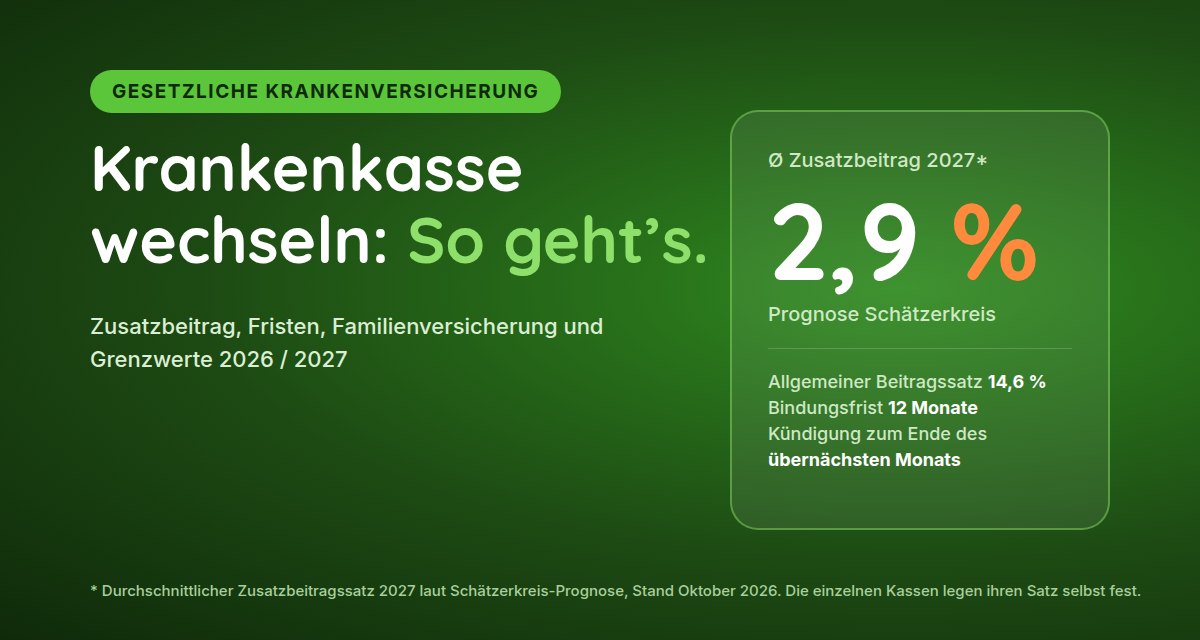
- Average additional contribution rate: in 2026 it is 2.9 %. According to the October 2026 forecast of the GKV estimation group (Schätzerkreis), it is expected to remain stable in 2027. Your insurer sets its own rate.
- Switching: after 12 months of membership, you can switch with two months' notice to the end of a month. If your insurer raises its additional contribution, you have a special termination right.
- Simple process: you join the new insurer. Since 2021, the termination with your old insurer has been handled electronically by the new insurer.
- Thresholds are expected to rise in 2027: contribution assessment ceiling, compulsory insurance threshold and the income limit for family insurance (draft regulation, approval by the Bundesrat still pending).
How your GKV contribution is made up
The contribution to statutory health insurance consists of the general contribution rate of 14.6 % and the additional contribution, which each health insurer sets itself. Both parts are levied on your contributory income up to the contribution assessment ceiling. As an employee, you pay half, and your employer pays the other half.
The average additional contribution rate is a reference value that the Federal Ministry of Health announces every year based on the Schätzerkreis. In 2026 it is 2.9 %. Individual insurers may be above or below it – which is why it pays to check your own insurer's rate.
Switching health insurers: how it works
- Check the minimum membership period: as a rule, you must have been a member of your insurer for 12 months.
- Choose a new insurer: compare the additional contribution, statutory extra benefits (e.g. subsidies for preventive check-ups or travel vaccinations), bonus programmes and service.
- Declare membership: you become a member of the new insurer. It notifies your previous insurer of the switch electronically – you no longer need to cancel yourself.
- Inform your employer: tell your employer the name of your new insurer. Your employer handles the social security notification.
- Note the deadline: the switch takes effect at the end of the month after next. Example: you join in November, the new insurer covers you from 1 February.
Special termination right if the additional contribution rises
If your insurer introduces an additional contribution for the first time or raises it, you can switch even before the 12 months are up. Your insurer must inform you of this in good time. You can use the special termination right until the end of the month for which the higher additional contribution is first charged. Until the switch takes effect, you continue to pay the higher contribution.
Important: if you take part in an optional tariff of your insurer (e.g. a deductible or a contribution refund), longer minimum membership periods may apply. Check this before you switch.
Thresholds 2026 and 2027 at a glance
| Figure | 2026 | 2027 (draft) |
|---|---|---|
| Contribution assessment ceiling for health and long-term care insurance | 5.812,50 € / month 69.750 € / year | 6.375 € / month 76.500 € / year |
| Compulsory insurance threshold (annual earnings limit) | 77.400 € / year | 84.150 € / year |
| Income limit for family insurance | 565 € / month | 590 € / month |
| Income limit for family insurance with a mini-job | 603 € / month | 633 € / month |
The figures for 2027 are taken from the draft Social Security Calculation Variables Regulation 2027 (Sozialversicherungs-Rechengrößenverordnung 2027), adopted by the Federal Cabinet in October 2026. The Bundesrat still has to approve it.
Family insurance: who is co-insured free of contributions?
Spouses or registered civil partners and children can be covered by family insurance without paying contributions in the GKV if their regular total income does not exceed the income limit. In 2026 this is 565 € per month, or 603 € with a mini-job. For 2027, 590 € and 633 € respectively are planned. Age limits also apply to children; in addition, special rules apply if one parent is privately insured and earns more than the parent with statutory insurance.
GKV or PKV?
If you are an employee earning more than the compulsory insurance threshold, you can switch to private health insurance (PKV). This decision needs careful thought: returning to the GKV later is often possible only to a limited extent. Find out more in our article Returning from PKV to GKV.
If you stay in statutory insurance, you can close gaps with supplementary insurance, for example for dentures and dental work, in hospital or for outpatient treatment. You will find tariffs in our overview of supplementary health insurance.
Special case: cross-border commuters to Switzerland
If you live in Germany and work in Switzerland, you have a right of option: within three months of starting work, you choose between Swiss basic health insurance (KVG) and insurance in Germany. This choice is usually permanent. Switching to another insurer within the German GKV later remains possible, but switching between KVG and GKV usually does not. Find out more on our page Health insurance for cross-border commuters.
How we help you
You choose your statutory health insurer yourself and declare membership directly with the new insurer. As an insurance broker, we support you with the related questions: which supplementary insurance suits you? Is PKV worthwhile for you – or not? And what applies to cross-border commuters? Our advice costs you no additional fee, because we are paid by the insurers.
Sources
- Bundesregierung: Contribution assessment ceilings 2027 adopted by the Cabinet (October 2026).
- Deutsche Rentenversicherung: Contribution assessment ceilings 2027 set to rise (08.10.2026).
- krankenkassen.de: Social security calculation variables 2027.
- krankenkasseninfo.de: Average additional contribution 2027 expected to remain stable (October 2026).
- §§ 3, 6, 10, 175, 242 SGB V.
Legal and editorial notice: this article reflects the situation as of October 2026 and is for general information only. It does not replace individual advice and is not legal or tax advice. The figures for 2027 are based on a draft regulation and the forecast of the Schätzerkreis; the final figures and your insurer's additional contribution may differ. KiS – Kontor im Schwarzwald GmbH, insurance broker licensed under § 34d Abs. 1 GewO, Reg.-Nr. D-PS74-61V96-00.
👉 Wondering whether GKV, PKV or supplementary insurance is right for you? Just get in touch with us – click Request advice